
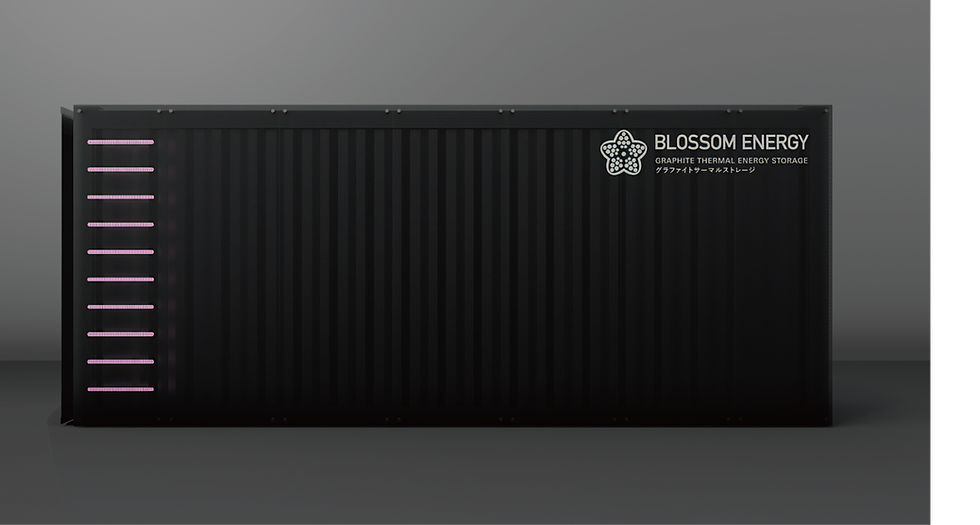
G-TES
If you store heat,
Fuel consumption can be reduced.
StoreHeat
Reduce Fuel
A new kind of energy that supports everything from making and transporting to living.
Renewable energy is stored as heat, ensuring a stable supply and lower costs.
The BlossomEnergyG-TES graphite thermal storage boiler is a system that uses graphite as a heat storage material to store renewable energy-derived electricity as heat and supply it stably when needed. It can supply heat up to 500°C in various forms such as steam, hot water, hot air, chilled water, and chilled air, depending on the application. It decarbonizes heat utilization in various settings, from the hot water and steam demands of manufacturing sites to hot water and heating for entire buildings, and even cooling, while also reducing energy costs.
How G-TES works

G-TES thermal storage performance data
Heat storage performance
Heat storage temperature
Maximum 1500℃
Heat storage capacity
200kWh
Environmental performance
CO₂ emissions
zero
fossil fuel use
zero
size
Body size
H2.9m × W2.4m × D6m
Heat supply performance
supply temperature
Maximum 500℃
Continuous supply time
20 hours
Economic performance
Fuel cost reduction
Approximately 40% (compared to conventional boilers)
Payback period
7-10 years (estimated)
WHY GRAPHITE MATTERS
The challenge of "heat," which accounts for 70% of energy consumption.
Heat, which accounts for approximately 70% of global energy consumption, is still largely generated by burning fossil fuels. To realize a society primarily powered by renewable energy, technologies that utilize electricity as a stable and low-cost heat source are essential.
Blossom Energy is addressing this fundamental challenge.

Strengths of G-TES

Converting renewable energy into thermal energy usable 24 hours a day.
Surplus electricity generated from solar power and other sources is stored as heat. By utilizing electricity on weekends and during the day, weekday fossil fuel consumption and energy costs are reduced.

From 500℃ steam
Suitable for both hot and cold temperatures.
It stores heat at a maximum of 1,500°C, and can be used not only for heating but also for cooling.

Space-saving, high-capacity heat supply
Surplus electricity generated from solar power and other sources is stored as heat. By utilizing electricity on weekends and during the day, weekday fossil fuel consumption and energy costs are reduced.

Automatically optimized control utilizing existing equipment
The system can be installed while utilizing existing boilers and heat supply equipment. Based on the operating status of the equipment and energy prices, G-TES automatically selects the most economical operating mode.

Resource-recycling material that can be used for 40 years
The graphite used in the heat storage material does not need to be replaced for approximately 40 years. It is naturally derived, has a low environmental impact, and can be recovered from CO₂ synthesis or used batteries.
The heat storage advantage of graphite compared to other materials.

Business effects brought about by G-TES

Decarbonization
DECARBONIZATION

Reduce CO2 emissions without relying on fossil fuels
Achieving 100% renewable energy utilization rate
Contributing to ESG management

Economic benefits
ECONOMICAL MERIT
Fuel costs reduced by 40% compared to conventional boilers.
No large-scale construction required
Payback period: 7 years (optimal evaluation)

WHY GRAPHITE MATTERS
The challenge of "heat," which accounts for 70% of energy consumption.
Output from 30°C to 500°C

vapor
Guideline: Low to medium pressure saturated steam
(Adjustable by design)
The stored high-temperature heat is supplied to the steam generator. This reduces the use of fossil fuels in various processes such as washing, sterilization, cooking, and raw material heating.

hot water
Recommended temperature: 65℃
(Adjusted according to design)
It provides a stable supply of hot water at the required time. By connecting to existing hot water storage tanks and heat exchangers, it reduces boiler operation, thereby lowering fuel costs and CO₂ emissions.

Hot air
Recommended temperature range: 30-500℃
(Adjusted according to design)
Provides a stable supply of warm air. Enables decarbonization and cost reduction in drying processes for paints, paper, food, etc. Allows for flexible control of temperature and airflow.

cooling
Applications: Air conditioning, cooling, and dehumidification in offices and hospitals.
(Adjusted according to design)
Absorption chillers provide chilled water and dehumidified air conditioning. They utilize off-peak electricity to reduce peak load and lower basic charges. They can also be used in conjunction with electric chillers.
Planned installation locations (including potential locations)

Land-based aquaculture facility
Replacing boilers used for seawater heating improves productivity.
Planned for one location in Hiroshima Prefecture from April 2026 onwards.

Hot spring facilities
Replacing hot water boilers reduces fuel costs.
Planned for one location in Hiroshima Prefecture from March 2025 onwards.
Furthermore, it will be expanded to multiple locations nationwide by 2026.

Paint drying oven
Decarbonizing the drying process, the largest source of CO₂ emissions in the manufacturing industry.
Demonstration testing to begin in July 2026.

Airport facilities
Reducing energy costs for air conditioning in large spaces
Implementation plans are underway for 2027 and beyond.